
Healthcare SaaS · AI · Judi Health · 2024–2025
Designing AI that pharmacists can trust
Prior authorization is the most complex module in Judi Health's pharmacy benefit platform. I designed the workflows that put AI to work on document review and clinical criteria, and the validation experience that earned users' trust while making the model smarter.
Role
Senior UX/UI Designer
Company
Judi Health
(formerly Capital Rx)
Users
Pharmacists, pharmacy techs, pharmacy admins, SaaS clients
Team
PM, lead Developer, AI engineer, pharmacist manager
28%
faster case handle time
95%
model accuracy, improved by user validation
54M+
members on the platform
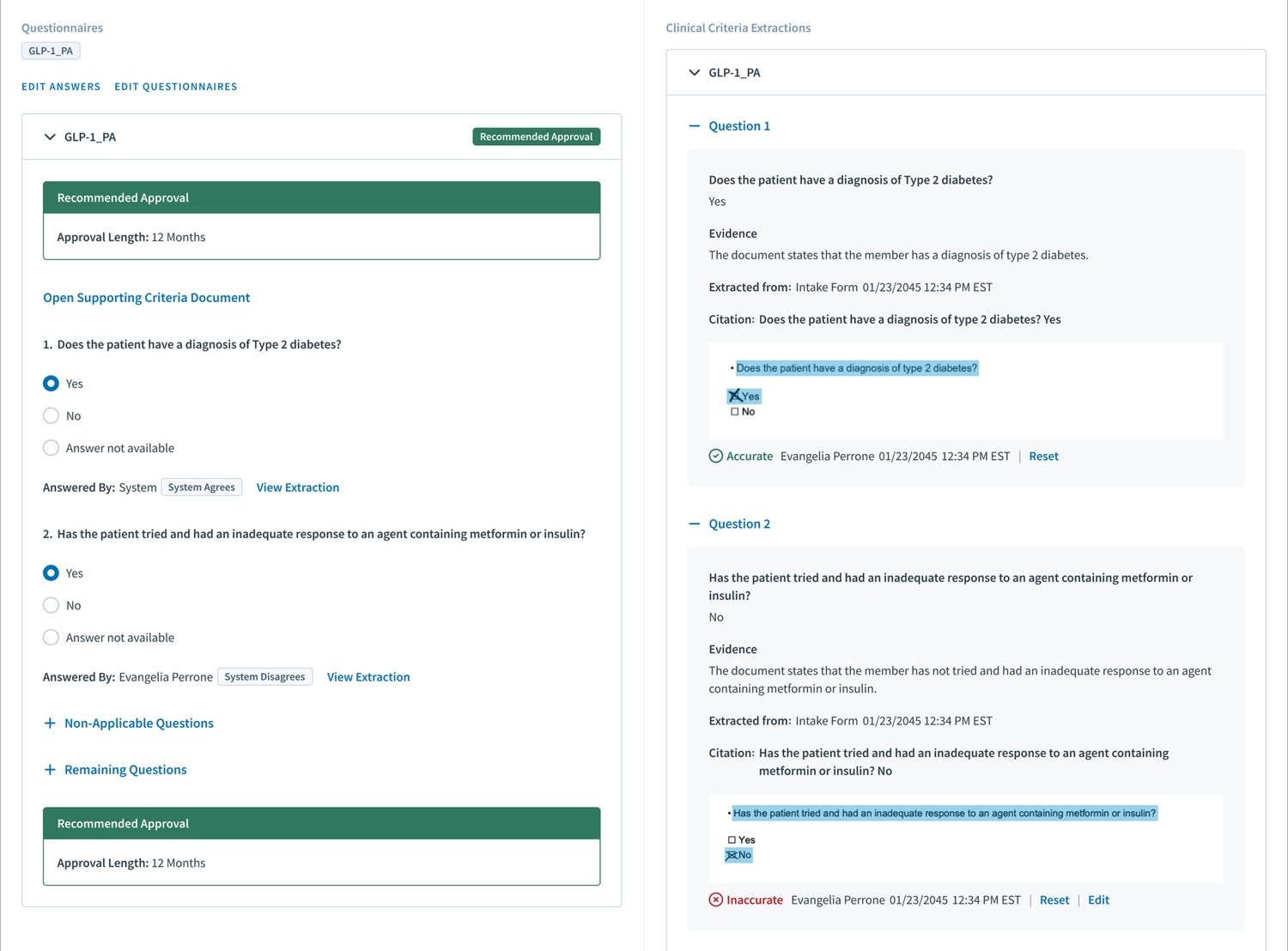
Pharmacists review what the AI extracted from faxes and documents.
They validate each AI answer in real time, inside the workflow.
Every validation becomes feedback for the AI engineers, which helped push accuracy past 95%.
The Problem
Prior authorization cases involve reviewing documents and faxes and answering clinical criteria questions, which is slow, manual work for pharmacists and technicians. Judi Health was adding AI to help automate those steps. But automation that people don't trust just adds one more thing to check. The real design problem wasn't "how do we automate this with AI”, it was how do you make a clinician comfortable acting on what an AI suggests?
What I Learned
Immersion first
I was new to prior authorization, so I started with the team's documentation, journey maps, and user feedback, then worked with stakeholders and pharmacists to find where time was lost.
The barrier was trust
The biggest challenge was getting users to trust and rely on the new AI features.
Trust comes from verifying
Users needed to check the AI’s work quickly, in the moment, without leaving their flow.
What I Did, And Why
Put validation in the workflow
Users confirm or correct each AI suggestion in real time as part of handling the case, instead of in a separate review step.
Trust builds one verified answer at a time, and handle time stays low. Every confirmation also became a labeled data point for the AI engineers, which is how accuracy climbed past 95%.
Make AI-extracted documents easy to review
An interface for reviewing what the AI pulled from faxes and documents.
Users need to confirm what the AI "read" before relying on anything built on top of it.
Remove work that never needed a human
Preemptive decisioning stops unneeded cases from being worked, communications take far fewer clicks, and user assignments give admins fine control over pharmacist workload.
Time saved compounds: faster cases for the pharmacy team, plus better control and efficiency for SaaS clients and admins.
I Also Shipped…
Communications updates
Greatly reduced clicks to send outbound and record inbound communications, especially urgent inbound phone calls.
User assignments
Gave admin users granular control of pharmacist workload and focus by allowing them to create work segments from an admin panel.
Figma file organization standards
Spearheaded an effort to set new file organization standards for the design team, so each designer’s file was easy to navigate.
The Result
Cases were handled 28% faster, more accurately, and with fewer clicks per action. Model accuracy rose to over 95%, helped by rapid validation from users. The gains reached the internal pharmacy team, SaaS clients, and admin users. The model gains were a joint effort with the AI engineers; the validation design is what made user feedback possible.